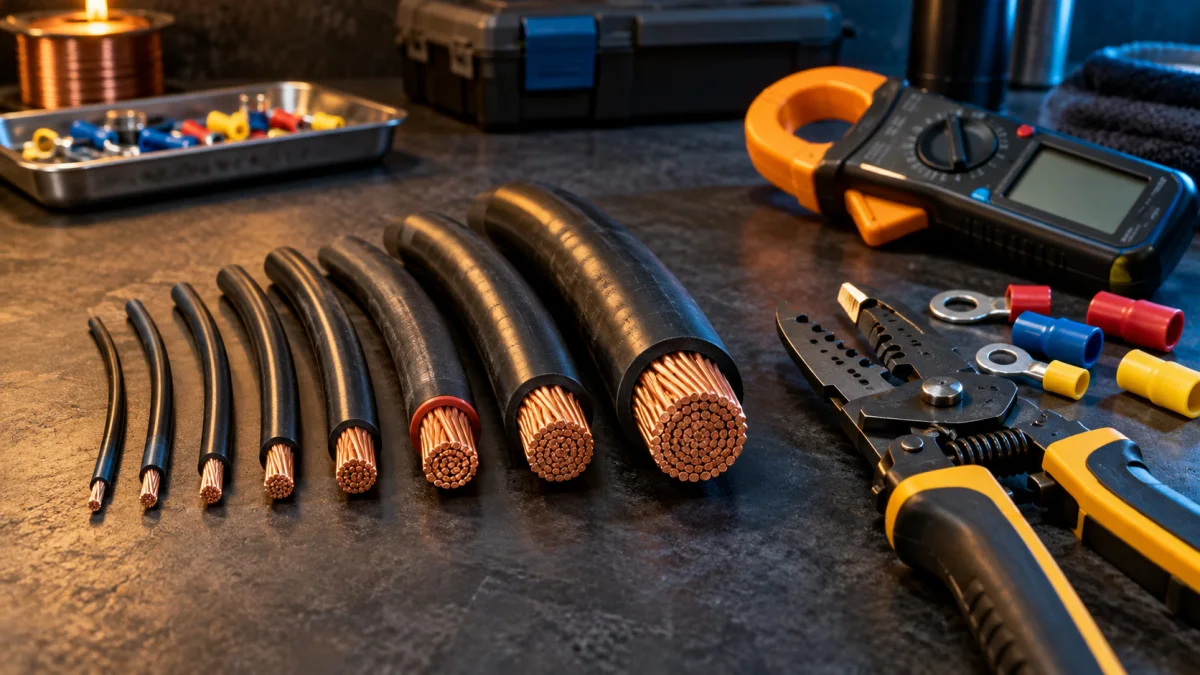
The current a cable carries is the main thing that decides how thick it needs to be. Undersize a cable and it overheats. This guide explains the relationship without turning into a wiring manual.
Why current sets wire size
Current flowing through any conductor generates heat, in proportion to the square of the current and the conductor resistance. Thicker conductors have lower resistance and dissipate heat more easily, so they can carry more current safely. That is why the first step is always to work out the current, which you can do in the current calculator.
Ampacity
Ampacity is the maximum current a cable can carry continuously without exceeding its temperature rating. Manufacturers and wiring codes publish ampacity tables by conductor size, insulation type, and installation method. You size a cable so its ampacity comfortably exceeds the load current.
What reduces ampacity
Bundling cables together, running them through insulation, and high ambient temperatures all reduce how much current a cable can safely carry. Codes apply derating factors for these conditions, which is one reason cable sizing is a job for someone who knows the local rules.
Voltage drop
Even a correctly rated cable loses some voltage along its length, and that loss grows with current and distance. On long runs, voltage drop rather than heat often dictates the size. Our voltage drop guide covers this in detail.
Staying safe
Use the current calculator to find the load current, then have a qualified electrician select the cable against the applicable ampacity tables and derating factors. Calculations get you the starting number, but the final choice must follow your wiring regulations.
A professional method for wire size and current
A dependable wire size and current result starts before any arithmetic. Identify the source, load, circuit type, and purpose of the answer. A quick operating estimate is different from a value used to select cable, protection, switchgear, or controls. Record where every input came from and state assumptions such as nominal voltage, balanced phases, steady operation, or room temperature. This discipline improves accuracy and lets another person reproduce the work.
Collect the correct inputs
Write down voltage, power, resistance, power factor, efficiency, phase arrangement, and duty cycle whenever they apply. Keep units visible. Convert kilowatts to watts, milliamps to amps, and percentages to decimals before substitution. Nameplate data usually describes a rated condition, while a meter captures one moment under a particular load. Neither should be used outside its context without explanation.
- Confirm the supply: distinguish DC, single-phase AC, and three-phase AC before choosing an equation.
- Verify voltage: use the line or phase voltage required by the formula, not an untested assumption.
- Identify power: determine whether the stated value is real input power, apparent power, or mechanical output.
- Consider operation: startup, cycling, temperature, waveform, and loading can change measured current.
- Separate calculation from selection: calculated amperage is an engineering input, not an automatic device rating.
Choose the formula from the circuit, not convenience
Ohm's law gives current from voltage and resistance. The power relationship gives current from watts and voltage for DC or a suitably resistive load. AC calculations may also require power factor, efficiency, and the square root of three. Select the relationship that represents the real system; do not force available numbers into the easiest equation.
Wire size and current: step-by-step workflow
- Define whether the required value is nominal, maximum, startup, branch, line, RMS, peak, or fault current.
- Classify the electrical system and select the matching relationship.
- Convert every input to compatible base units and label it clearly.
- Substitute values while retaining useful intermediate precision.
- Round only the final result and state the operating assumptions beside it.
- Apply design margins, correction factors, and code rules separately so the raw calculation stays traceable.
- Compare the answer with a nameplate, manufacturer table, suitable measurement, or independent second method.
Reasonableness checks that catch errors
Ask whether the direction of change makes physical sense. At fixed power, reducing voltage generally raises current. At fixed voltage, increasing load generally raises current. A result that differs greatly from a nameplate or typical value often indicates a unit conversion, phase, efficiency, or power-factor error. Recalculate with rounded values mentally; the rough answer should be in the same range.
Precision must reflect the inputs. Several decimal places do not create accuracy when voltage and power are approximate. For most practical estimates, a sensible rounded ampere value plus clearly documented assumptions is more useful than a long calculator output.
Practical reference checks
| Check | Why it matters | Professional action |
|---|---|---|
| System type | DC and AC phase arrangements use different relationships. | Identify the supply before selecting the formula. |
| Input units | Kilo, milli, line, or phase mismatches can change the answer dramatically. | Convert and label every value first. |
| Operating state | Startup, partial load, heat, and waveform affect real current. | State whether the result is nominal, measured, or worst case. |
| Design limits | Cables and protective devices follow ratings and code rules. | Check manufacturer data and applicable standards. |
Applying wire size and current in real work
Equipment and circuit planning
Use the calculated current to understand load demand, compare equipment, and begin a circuit plan. Next check conductor ampacity, voltage drop, terminal ratings, protective-device characteristics, ambient temperature, grouping, and installation method. Motors and electronic power supplies can draw starting or inrush current well above their steady value, so a running-current answer alone may not describe switching or protection needs.
Measurement and verification
When measurement is appropriate, use an instrument and accessories rated for the circuit category and expected magnitude. A clamp meter avoids opening a conductor but must surround the correct conductor rather than an entire multi-core cable. Direct current measurement often requires series connection and can be hazardous if attempted incorrectly. De-energize where procedures require it and leave hazardous work to qualified personnel.
Documentation for future decisions
Record the date, equipment state, supply voltage, formula, raw values, result, and any correction factors. Good notes turn wire size and current from a one-off answer into maintainable engineering information. If equipment changes, the earlier calculation can be updated without guessing why a particular breaker, cable, or control setting was selected.
Common mistakes and how to avoid them
- Mixing watts and kilowatts or amps and milliamps without conversion.
- Using nominal voltage when measured operating voltage is materially different.
- Ignoring power factor or efficiency for AC equipment and motors.
- Confusing line-to-line voltage with line-to-neutral or phase voltage.
- Treating a typical operating value as a guaranteed maximum.
- Rounding intermediate values so aggressively that the final answer shifts.
- Using a load-current result as a substitute for fault-current, thermal, or protection analysis.
Natural keyword use supports both readers and search engines. Phrases such as wire size and current, electrical current, amperage, voltage, power, resistance, and circuit calculation belong where they explain the method. Repeating them without adding meaning reduces clarity. Complete answers, correct terminology, useful examples, and a logical heading hierarchy are stronger signals than forced repetition.
Conclusion
Wire size and current becomes manageable when the system is identified, inputs are normalized, and the correct formula is applied. Keep the raw calculation separate from later design margins and confirm that the direction and size of the result are reasonable.
Use the Current Calculator for a fast estimate, then verify important decisions with equipment documentation and applicable electrical standards. Cable sizing, protective coordination, fault studies, and work on energized systems should be confirmed by a qualified electrician or electrical engineer.
Frequently Asked Questions
Record the circuit type, source voltage, load rating, units, operating condition, and assumptions. This makes the result easy to check and update.
Use it as a starting estimate. Final cable, breaker, switchgear, and equipment selections must follow manufacturer data, installation conditions, applicable codes, and professional review.
Yes. More current means more heat, so a thicker conductor with lower resistance is needed to carry it safely.
Ampacity is the maximum current a cable can carry continuously without exceeding its safe operating temperature.
On short runs, heat usually governs. On long runs, voltage drop often decides the cable size before heat does.